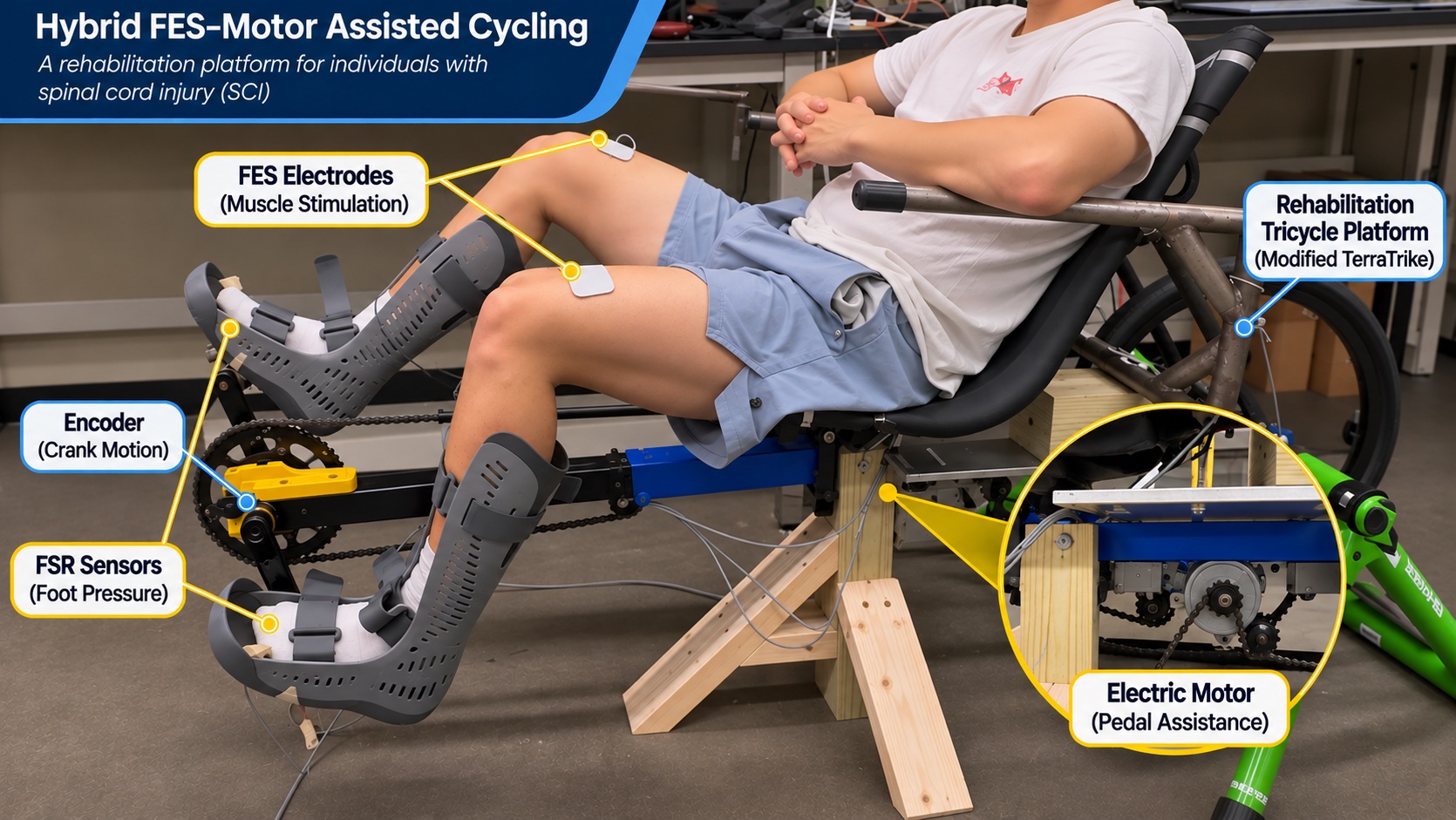
Hybrid FES cycling rehabilitation training
Training materials that help people with spinal cord injury, caregivers and clinicians use motor-plus-FES cycling safely.
Department of Mechanical Engineering, The University of Alabama
We develop robotic devices and control strategies that provide personalized assistance and help people overcome mobility challenges.
Our goal is to improve quality of life for older adults and people living with mobility deficits caused by stroke, spinal cord injury, and so on.
The lab brings together biomechanics, neuromusculoskeletal modeling and control, and human-centered artificial intelligence. We build wearable and rehabilitation robots, sense muscle activity with surface electromyography and ultrasound imaging, and design controllers that adapt assistance to each person.
54 publications, 11 research projects, 13 current members and 13 alumni since 2023.
Training materials that help people with spinal cord injury, caregivers and clinicians use motor-plus-FES cycling safely.

Deep learning on ultrasound and sEMG signals to recognize gestures and predict continuous finger motion.

A modular cable-driven robot that applies controlled forces at the pelvis for balance and walking training.
Paper Journal paper led by Oluwasegun Akinniyi has been accepted in the IEEE/ASME Transactions on Mechatronics.
Funding The lab received the College Opportunity for Research Equipment (CORE) support for the Exo-H3 full lower-limb robotic exoskeleton.
Service Dr. Zhang was appointed Associate Editor of IEEE Transactions on Automation Science and Engineering (T-ASE).
Funding The lab received a $37,500 DHPRC Pilot & Feasibility grant to develop pressure injury monitoring with ultrasound.
Paper Oluwasegun Akinniyi's first lead-author journal paper was accepted in the ASME Journal of Biomechanical Engineering.
Paper Our paper on objective- and speed-agnostic human-in-the-loop reinforcement learning control of hip exoskeletons was published in IEEE T-ASE.
A Modular Cable-Driven Pelvic Robot for Rehabilitation Training - Design, Adaptive Control, and Preliminary Biomechanical Characterization
IEEE/ASME Transactions on Mechatronics, 2026. Accepted
Plantarflexor Activation and Muscle Architectural Responses During Reactive Stepping under Waist-Pull Perturbations
ASME Journal of Biomechanical Engineering, 2026. Accepted
IEEE Transactions on Automation Science and Engineering, vol. 23, pp. 16413–16427, 2026.
IEEE Transactions on Neural Systems and Rehabilitation Engineering, vol. 34, pp. 3119–3131, 2026.
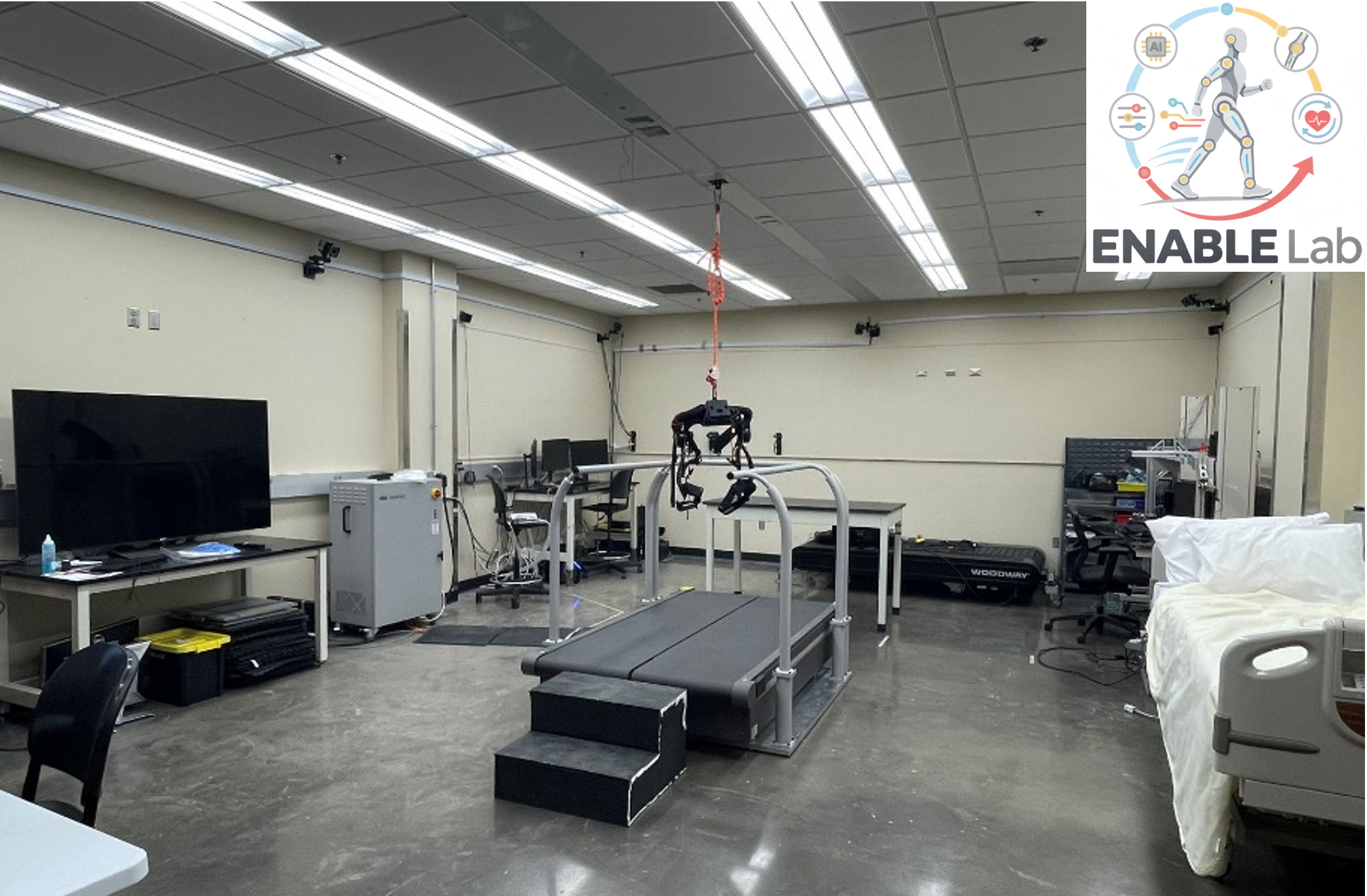
Our lab occupies research space in the South Engineering Research Center (SERC) on the UA campus, with wearable robots, ultrasound imaging, EMG and functional electrical stimulation systems, and robotic platforms for control research.
We have an open Ph.D. position, and we welcome UA undergraduates who want research experience.