Research
The ENABLE Lab combines dynamic systems and control, biomechanics, neuroscience and artificial intelligence to build wearable robots that improve mobility, balance and rehabilitation, mainly for older adults and people with neurological conditions. Our work spans human–machine interaction, neuromuscular modeling and reinforcement learning-based control.
11 projects
-
Artificial intelligenceActive
FDT-BioTech: Biosignals Fusion-Informed Neuromusculoskeletal Reconstruction in Immersive Digital Twin for Personalized Stroke Gait Rehabilitation Using Lower-Limb Exoskeletons
An immersive digital twin that personalizes lower-limb exoskeleton gait training after stroke.
-
Biomedical devicesActive
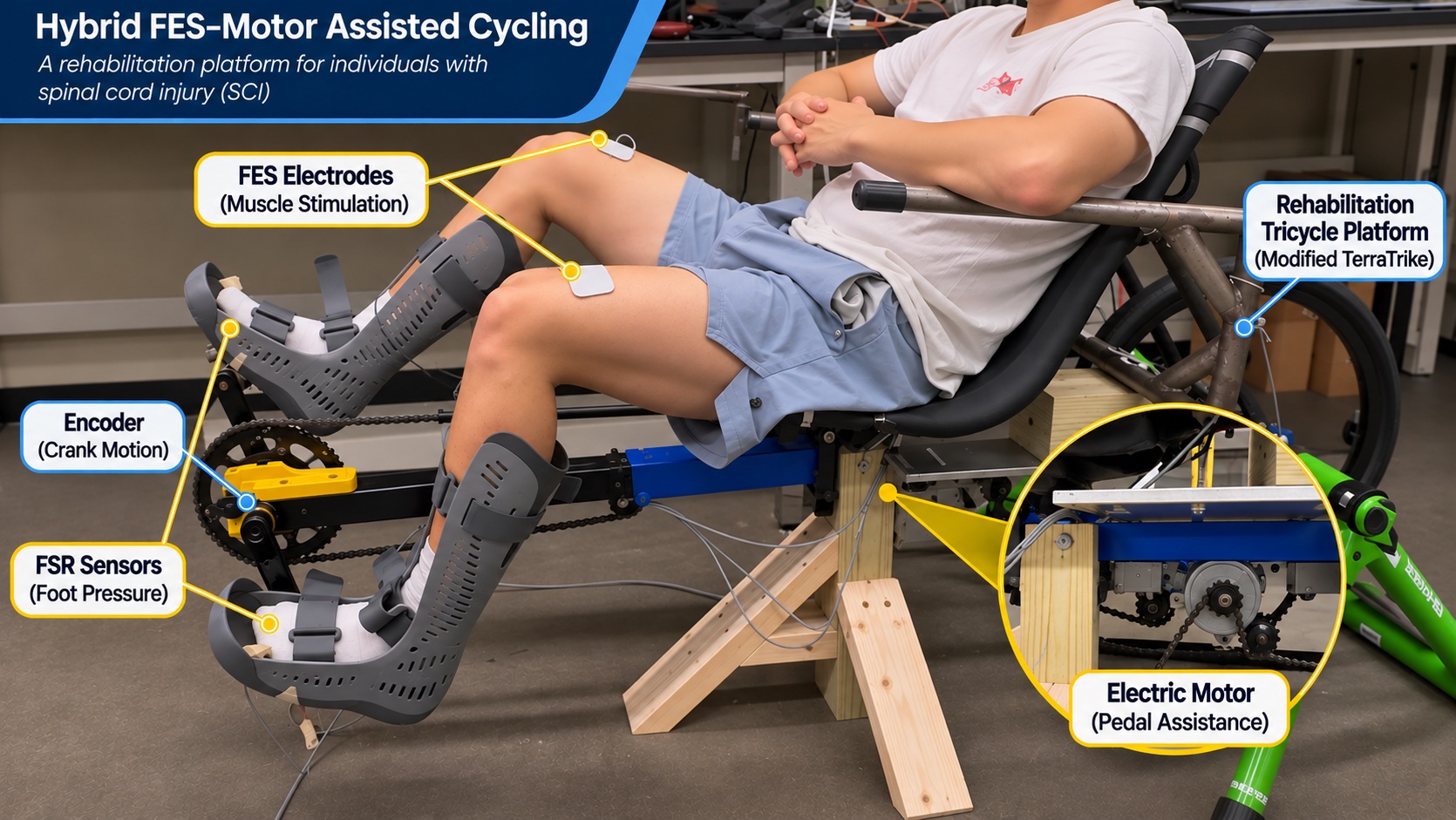
Hybrid Cycling Rehabilitation Training Using Functional Electrical Stimulation and Motorized Assistance
Training materials that help people with spinal cord injury, caregivers and clinicians use motor-plus-FES cycling safely.
-

Artificial intelligence
Neuromuscular Signal Fusion-Based Finger Movement Prediction and Control of Prosthetic Hands
Deep learning on ultrasound and sEMG signals to recognize gestures and predict continuous finger motion.
-

Robotics and controls
Modular Cable-Driven Pelvic Robot Development for Rehabilitation Training
A modular cable-driven robot that applies controlled forces at the pelvis for balance and walking training.
-

Wearable technologies
Wearable Bilateral Hip Exoskeleton Development for Locomotion or Balance Assistance
A wearable exoskeleton that assists both hips during walking and balance recovery.
-

Robotics and controls
Assistance Personalization Control for Wearable Robotic Exoskeletons
Human-in-the-loop reinforcement learning and adaptive optimal control that tune exoskeleton assistance to each user.
-

Wearable technologies
Fused Ultrasound Imaging and sEMG-Based Control of a Cable-Driven Ankle Exoskeleton
Assist-as-needed ankle exoskeleton control driven by fused ultrasound and sEMG signals.
-

Biomedical devices
Ultrasound Imaging-Based Closed-Loop Control of FES for Drop Foot Correction
Closed-loop functional electrical stimulation guided by ultrasound imaging to correct drop foot.
-

Biomedical devices
AI-Driven Robotic Ultrasound System for Automated Neuromuscular and Cardiovascular Imaging and Assessment
A robot arm that positions an ultrasound probe automatically to image and assess muscles and blood vessels.
-

Artificial intelligence
Neuromuscular Feature Extraction from sEMG and Ultrasound Imaging for Joint Function Characterization
Extracting muscle features from sEMG and ultrasound to characterize joint function and predict joint moments.
-

Robotics and controls
Multiple Robotic Platforms for the Development of Control Approaches
A Baxter manipulator, a Kinova arm and quadcopters used to develop and test control methods.